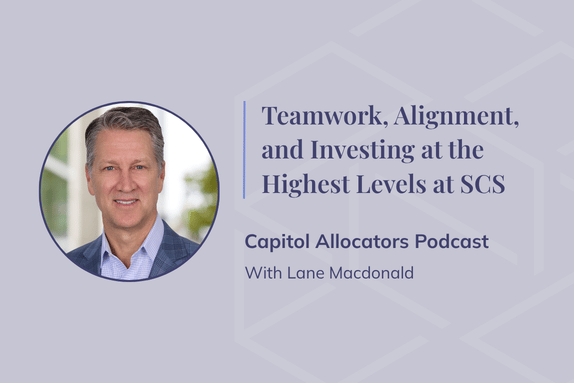



At a recent SCS Financial event in Boston, Anne Walsh, CIO of Guggenheim Partners, joined a panel with Lane McDonald, CIO, and Steve Perry, CIO of Public Markets at SCS. Here are some of the key insights and recap from their dynamic discussion.
The Economic Landscape: A Tale of Two Economies
To kick off the discussion, Steve Perry, CIO of Public Markets at SCS asked Anne Walsh, CIO of Guggenheim Partners, for her take on the economy and her outlook over the next 12 to 24 months.
Walsh described today’s economy as “bifurcated”— a term that captures the uneven recovery across sectors. She shared:
“We’re in a late bull market cycle with a bifurcated economy — the higher-end consumers and larger businesses are faring better than the interest-sensitive parts and lower-end consumers.”
This divergence has implications for investors. Resilient headline GDP growth continues to support equity and credit markets, but pockets of weakness, particularly among small businesses and lower-income households, signal some caution may be warranted.
Policy Crosscurrents: Tariffs, Deficits, and Volatility
Beyond interest rates, policy uncertainty looms large. Tariffs, deficits, and regulatory shifts create volatility that can unsettle markets. Walsh noted that tariffs often act like a “national sales tax,” creating a one-time inflationary bump but primarily dampening demand. She pointed to April’s “Liberation Day” tariff announcement, which briefly sent the S&P 500 down nearly 20%, as a reminder of how abrupt policy moves can roil markets given the importance of the US on the global stage.
While tariffs have had an inflationary impact, this has been somewhat muted by disinflationary phenomenon such as technology and deregulation. Walsh expects the effects of tariffs to work through the system by mid-2026, assuming no escalation. Her advice: “Separate the signal from the noise” — fundamentals, not headlines, drive long-term outcomes.
AI: A Generational Investment Opportunity
Perry shifted the conversation to technology and the transformative role of artificial intelligence. Lane McDonald described AI as “a generational investment opportunity that we need to take advantage of” and emphasized its potential to reshape industries and daily life:
“Artificial intelligence is an extraordinary revolution that is going to transform every part of our lives and will be used on a daily basis. But it requires a thoughtful, disciplined approach with an eye towards the long-term.”
Rather than chasing short-term trends, SCS focuses on disciplined, diversified exposure across public and private markets. This includes investments in venture-backed companies driving innovation, infrastructure such as data centers and power transmission that support AI growth, and public equities positioned to benefit from technological advancements. The goal is to capture the long-term opportunity that AI presents while being mindful of concentration and thoughtfully allocating across asset classes.
To SCS, AI is not just a technology trend — it’s a structural shift. By approaching it strategically with a long-term investment horizon, investors can participate in its growth while adhering to the principles of diversification and risk management that underpin sound wealth planning.
If you’re interested in exploring AI’s potential in innovation and investment further, SCS provides an in-depth perspective here.
Public vs. Private Equity: Playing the Long Game
Recent years have seen strong public equity returns outpacing private markets, but history tells a different story. Over rolling 10-year periods, private equity has historically outperformed by roughly 500 basis points1. McDonald stressed consistency:
“We believe the single greatest advantage for our clients is the duration of capital. We recommend clients play through cycles to capture long-term returns and avoid market timing.”
SCS believes in a multi-asset class approach that invests in both public and private equities. While public markets can offer liquidity and transparency, private equity can offer compensation for illiquidity with alpha potential through operational improvements, strategic growth, and value creation that compounds over time. For investors with patience and flexibility, private markets remain a critical driver of portfolio resilience.
Learn more on SCS’s perspectives on long-term private marketing investing here.
SCS’s Strategic Takeaways
For investors, the takeaways are:
- Focus on an asset allocation framework as a north star – combine assets that serve distinct and well-defined roles to maximize wealth compounding, net of taxes and fees, within one’s tolerance for risk and illiquidity, and to help weather different market cycles, regimes, as well as news and technology cycles.
- Use duration of capital to your advantage – capitalize on the long-term return potential of private markets and SCS’ access to managers and related co-investment flow to compound wealth.
- AI presents a generational opportunity, but important risks remain – AI has the potential to drive significant productivity gains, corporate earnings growth, and long-term GDP expansion. However, AI remains nascent, making it difficult to identify durable winners at this stage. Capital investments to advance models remain very high, and monetization is still in the early innings. Our approach has been to provide clients with thoughtful exposure to established and emerging businesses across both the public and private ecosystems.
- Private equity performance comparison is based on the Cambridge Associates Private Equity Index relative to the S&P 500 Index over rolling 10-year periods.