


At SCS, we believe that understanding emerging technologies is essential to helping our clients navigate a rapidly changing world. Artificial Intelligence (AI) is not just another innovation; it represents a fundamental shift in how information is processed, decisions are made, and value is created. As AI continues to reshape industries and investment landscapes, we’re committed to sharing insights that help our clients stay informed, prepared, and positioned for long-term success.
AI as the Next Computing Paradigm
Each wave of innovation — from microprocessors to cloud computing — has expanded our ability to compute, connect, and deliver information. AI builds on that foundation by introducing reasoning, autonomy, and generative intelligence at scale. It’s a leap from tools that respond to commands to systems that can plan, learn, and act independently.
Where We Are Today and Looking Ahead
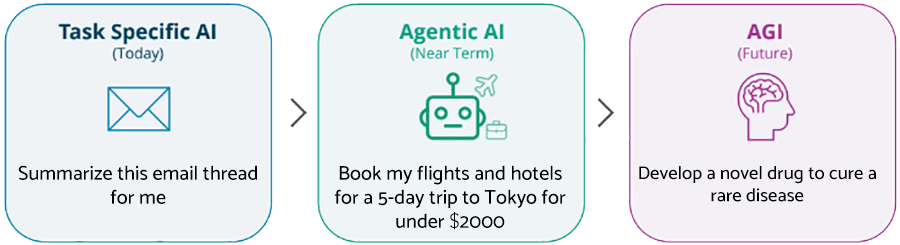
Most AI systems today are narrow in scope, designed for specific tasks like fraud detection, chatbots, or recommendation engines. These tools are already embedded in everyday workflows, but they represent only the beginning. The next phase, agentic AI, will bring systems capable of pursuing goals, making decisions, and adapting in real time.
Agentic AI marks a major milestone on the path toward Artificial General Intelligence (AGI), AI with human-like flexibility across domains. While AGI remains speculative, the pace of innovation suggests that increasingly autonomous systems will become more common in the future.
Lessons from the Tech Bubble: Why Fundamentals Matter
AI’s rapid rise has drawn comparisons to the dot-com boom of the late 1990s. Back then, excitement outpaced earnings, and many companies failed. But the infrastructure built during that era laid the groundwork for today’s tech giants. While there are some who draw parallels between AI and the Tech Bubble at the turn of the century, we do not believe today’s market is as exuberant. During the 1995–2002 period, technology stocks rose roughly 800%, with valuations peaking near 60x P/E before collapsing when growth failed to materialize.
In contrast, today’s tech stocks are up ~150% since late 2022 and trade closer to 30x P/E – elevated but well below historical extremes. Importantly, some of today’s leading tech firms combine strong profitability, robust growth, and healthier balance sheets – creating a potentially more durable foundation than their 2000-era counterparts. Still, history reminds us that perceived leaders can lack staying power (like Yahoo in the early 2000s), underscoring the importance of maintaining diversification across regions, styles, and companies.
Understanding the AI Ecosystem
AI is not a single technology; it’s a layered and interconnected ecosystem. Breaking it down into three core components helps clarify how innovation is unfolding and where value may accrue:
- Infrastructure: This forms the backbone of the AI ecosystem — semiconductors, cloud platforms, specialized hardware, and the vast energy resources required to power them. Together, these components deliver the compute, storage, and networking capabilities essential for training advanced models and deploying them on a global scale.
- Enablement: These are the platforms, models, and developer tools that transform raw computing power into usable intelligence. From large language models to specialized frameworks, enablement technologies bridge the gap between infrastructure and real-world applications and allow developers to build increasingly sophisticated systems.
- Applications: This is where AI meets the end user — from search to software development to autonomous driving. These companies create value by embedding AI into workflows, unlocking productivity, and transforming industries.
By viewing AI through these three lenses, investors and businesses can better understand the dynamics of the ecosystem and the opportunities and risks that come with it.
Monitoring Momentum and Risk
The scale of AI investment is unprecedented. Major players like Nvidia, OpenAI, and Oracle are forming deep partnerships, while governments are stepping in to support strategic development.
We are closely monitoring the expanding and interconnected network of AI-related investments, partnerships, and capital flows. This ecosystem — spanning hardware, software, infrastructure, and energy — has become a defining feature of the current market environment, with a handful of key players at its center. Much of this momentum centers around Nvidia and OpenAI, whose collaborations are reshaping the AI landscape.
The pace and interconnected nature of recent deals have drawn scrutiny from some observers who worry that the surge in activity could be fueling valuations faster than underlying profits. At the same time, others view these partnerships as necessary to meet unprecedented demand for AI capabilities. Across Washington, policymakers have largely adopted a supportive stance, seeing AI innovation as critical to U.S. competitiveness.
AI at SCS Financial: Embracing Innovation with Perspective
As AI continues to evolve, SCS is actively exploring how these technologies can enhance our internal operations and client experience. We’re engaging with strategic partners, evaluating emerging tools, and leveraging enterprise platforms to improve efficiency, data quality, and decision-making across the firm.
From automating routine processes to enhancing reporting and collaboration, our goal is to thoughtfully integrate AI in ways that support our people, strengthen our workflows, and ultimately deliver better service for our clients.
AI is reshaping the way we work, communicate, and invest. As with past innovation cycles, the key is to stay informed, remain diversified, and ground decisions in long-term fundamentals. At SCS, we’re committed to helping our clients navigate this evolving landscape with clarity and confidence.