



Qualified Small Business Stock (“QSBS”) is original-issuance, C-corporation stock that can create significant tax benefits for early-stage investors and founders of certain businesses. Specifically, if QSBS is held for the required holding period, up to 100% of the capital gain may be excluded from federal tax, subject to limitations described below.
Due to recent legislative changes, QSBS planning has gained traction. First, the Tax Cuts and Jobs Act enacted in 2017 reduced the corporate income tax rate from 35% to 21%, creating incentives for founders and investors to reconsider the C-Corporation structure. More recently, the One Big Beautiful Bill Act (“OBBBA”) of 2025 expanded QSBS benefits and eligibility requirements. Together, these laws create meaningful opportunities for tax savings on a future QSBS sale, especially when coupled with thoughtful planning.
How You May Qualify for QSBS and Why It Matters
QSBS generally refers to stock in a domestic C corporation that satisfies certain requirements under Internal Revenue Code §1202, including:
- The corporation’s aggregate gross assets must not exceed $50 million at all times prior to and immediately after stock issuance. For QSBS acquired after July 4, 2025, this threshold increases to $75 million and will be indexed for inflation pursuant to the OBBBA.
- The corporation must be actively engaged in a “qualified trade or business.” While many operating companies qualify, certain fields are excluded, including health, law, engineering, architecture, accounting, actuarial science, performing arts, consulting, athletics, financial services, brokerage services, banking, insurance, financing, investing, leasing, farming, mining, and hotels or restaurants.
- The stock must be acquired directly from the issuing company (for example, as a founder, early employee, or investor at issuance).
- Required holding periods vary depending on when the QSBS was acquired. Generally, stock acquired on or before July 4, 2025 must be held for more than five years to qualify for an exclusion. For QSBS acquired after July 4, 2025, partial exclusions may be available after three or four years, with a potential full exclusion after five years.
If these criteria are met, §1202 may permit eligible taxpayers to exclude some or all of the gain on the sale of QSBS for federal income tax purposes, subject to a per taxpayer, per issuer limitation equal to the greater of (i) $10 million for QSBS acquired on or before July 4, 2025 (or $15 million for QSBS acquired after that date, indexed for inflation after 2026), or (ii) ten times the taxpayer’s aggregate adjusted basis in the issuer’s QSBS sold during the taxable year. With careful structuring, certain gifting strategies may allow families to spread these exclusions across multiple taxpayers, subject to anti abuse rules.
QSBS Gain Exclusion by Stock Acquisition Date
Date of Stock Acquisition | Gain Exclusion (after required hold) |
|---|---|
| Aug 11, 1993 – Feb 17, 2009 | 50% of gain excluded (if held > 5 years). (50% taxable portion at 28% rate; excluded portion was subject to AMT prior to 2010) |
| Feb 18, 2009 – Sep 27, 2010 | 75% of gain excluded (if held > 5 years). (25% taxable portion at 28%; small AMT preference on excluded portion) |
| Sep 28, 2010 – July 4, 2025 | 100% of gain excluded (if held > 5 years). (No federal tax on gain; no AMT on excluded gain.) |
| After July 4, 2025 (OBBBA law) | 50% excluded if held ≥3 years; 75% if held ≥4 years; 100% if held ≥5 years. (The taxable portion, if any, is generally taxed at 28% and may also be subject to the 3.8% net investment income tax.) |
Source: “Scratching the 7-Year Itch: Quantum QSBS Exclusions,” 60th Annual Heckerling Institute on Estate Planning (Jan. 2026) Consiglio Advisors
If you own QSBS but have not yet met the holding period required for gain exclusion under IRC §1202, the taxpayer may have a “second chance” for gain deferral under IRC §1045. If the QSBS has been held for more than six months and is then sold, but the proceeds are reinvested in new QSBS within 60 days, then, the taxpayer may elect to defer recognition of the gain under §1045.
The holding period of the original QSBS is added to the holding period of the replacement stock, potentially allowing the new shares to qualify for §1202 exclusion upon a future sale. Importantly, the basis of the newly acquired QSBS will be reduced by the amount of the deferred gain. This fact should be considered when the 10× basis alternative could result in meaningful savings as described in the next section.
Changes to QSBS as a Result of the OBBBA
The OBBBA included many meaningful changes for taxpayers, including updates to QSBS eligibility criteria that makes this form of exclusion an option for more stockholders by:
- Shortening the holding periods for QSBS eligibility, allowing some business owners to receive at least partial gain exclusion after just 3 years instead of 5 years;
- Expanding the number of companies eligible for the exclusion by increasing the aggregate gross-assets ceiling to $75 million (with inflation adjustments beginning after 2026); and,
- Increasing the fixed-dollar limitation from $10 million to $15 million per taxpayer, per issuer (also indexed for inflation after 2026).
These changes create enhanced flexibility on exit timing for certain QSBS holders and the potential for greater tax exclusion. However, they only apply to QSBS acquired after July 4, 2025 and are not retroactive.
Leveraging QSBS to Eliminate Gain and Transfer Wealth
Lifetime gifting, when structured effectively, can be a powerful tool, as it can remove an asset plus all future appreciation on that asset from the donor’s taxable estate. Individuals have many options to transfer wealth out of their estate and to loved ones, including taxable gifts that use some or all of their lifetime gift and estate tax exemption ($15 million per person in 2026). Those who have used all of their exemption may opt to continue to transfer assets by making a taxable gift and paying federal gift tax (40%) or leveraging strategies known as “freeze techniques,” which remove future appreciation on an asset from your estate. The tax benefits of these strategies may be enhanced by leveraging QSBS.
As noted above, the QSBS exclusion is available per taxpayer, per issuer. Thus, an individual who owns QSBS that exceeds the current exclusion limits may take advantage of additional tax savings by transferring stock to separate taxpayers, including family members and non-grantor trusts (trusts that are responsible for paying their own income tax and have a separate taxpayer identification number) for the benefit of loved ones. When QSBS is transferred by a gift, the recipient steps into the shoes of the original stockholder from an original issuance and issuance date perspective, allowing the exclusion to be preserved across multiple taxpayers. When properly structured, each eligible recipient of QSBS can separately claim its own exclusion of up to $10 or $15 million, depending on when the stock was issued. This strategy, often referred to as QSBS stacking, can reap significant income tax savings.
Potential QSBS Planning Pitfalls
QSBS planning must be executed with care. One must balance the income tax advantages with the gift tax consequences of transfers and be wary of anti-abuse rules that treat multiple non-grantor trusts as one taxpayer (and thus eligible for only one QSBS exclusion) if they have the same grantor and substantially similar beneficiaries. In addition, as is often the case for planning with stock ahead of a liquidity event, making the gift well ahead of the potential sale is advisable to avoid IRS scrutiny.
The QSBS exclusion can offer meaningful federal capital gains tax savings. However, state treatment does not necessarily follow the federal exclusion and may change over time. California, Pennsylvania, Mississippi and Alabama have historically not fully followed federal QSBS exclusion. Thus, it is possible for a QSBS holder to eliminate part or all of their capital gains tax at the federal level but still owe state level tax upon sale of the stock. It is crucial to understand in which states you may personally be subject to income tax, and when transferring QSBS to a non-grantor trust, work with advisors to understand the trust situs and whether the trust will be subject to taxation in one or more states.
Enhancing Potential QSBS Benefits for Capital Intensive Companies
In addition to enhancing QSBS benefits, the OBBBA made permanent the provisions under §168(k) allowing for 100% bonus depreciation of qualified capital purchases, such as equipment and machinery. The immediate expensing of corporate assets significantly lowers tax-basis, which enables capital-intensive startups to raise cash, invest heavily in fixed assets, and keep their aggregate gross assets, used to determine QSBS eligibility, consistently low. Similarly, the OBBBA reversed prior law that required companies to capitalize and amortize domestic research and development (R&D) costs over five years. Beginning in 2025, these expenditures can once again be immediately deducted, further helping companies maintain a lower asset base on their balance sheets. The ability to fully expense R&D spending can significantly reduce the reported assets of technology and biotech companies that are aggressively investing in innovation. As a result of these changes, larger startups that are actively reinvesting in their growth may appear smaller for a longer period, thereby preserving QSBS eligibility for longer periods of time.
Consider a simplified example of QSBS held by early-stage venture capital investors and founders who may foresee multiple rounds of stock issuance to fund operations. Each time the company raises capital, the QSBS requirements must be met, and a new holding period begins for each new issuance. It is plausible for Seed and even Series A and B rounds to qualify for QSBS under the $75M gross-assets ceiling (for post-OBBBA stock), especially for capital-intensive businesses that place depreciable assets into service incurring significant operating expenses. Each qualifying tranche of stock could potentially aggregate for the 10× basis limitation for gain exclusion. In this hypothetical scenario, founders and investors could accumulate potential gain exclusion well beyond the fixed-dollar limitation when subsequent qualifying rounds are considered in an ultimate sale. See below an illustration in which multiple funding rounds could result in a large, aggregate exclusion as a result of the various components of OBBBA working together to “supercharge” QSBS benefits.
Cumulative Gross Assets Illustration:
$85MM * 10x Basis or $850MM Gain Exclusion?
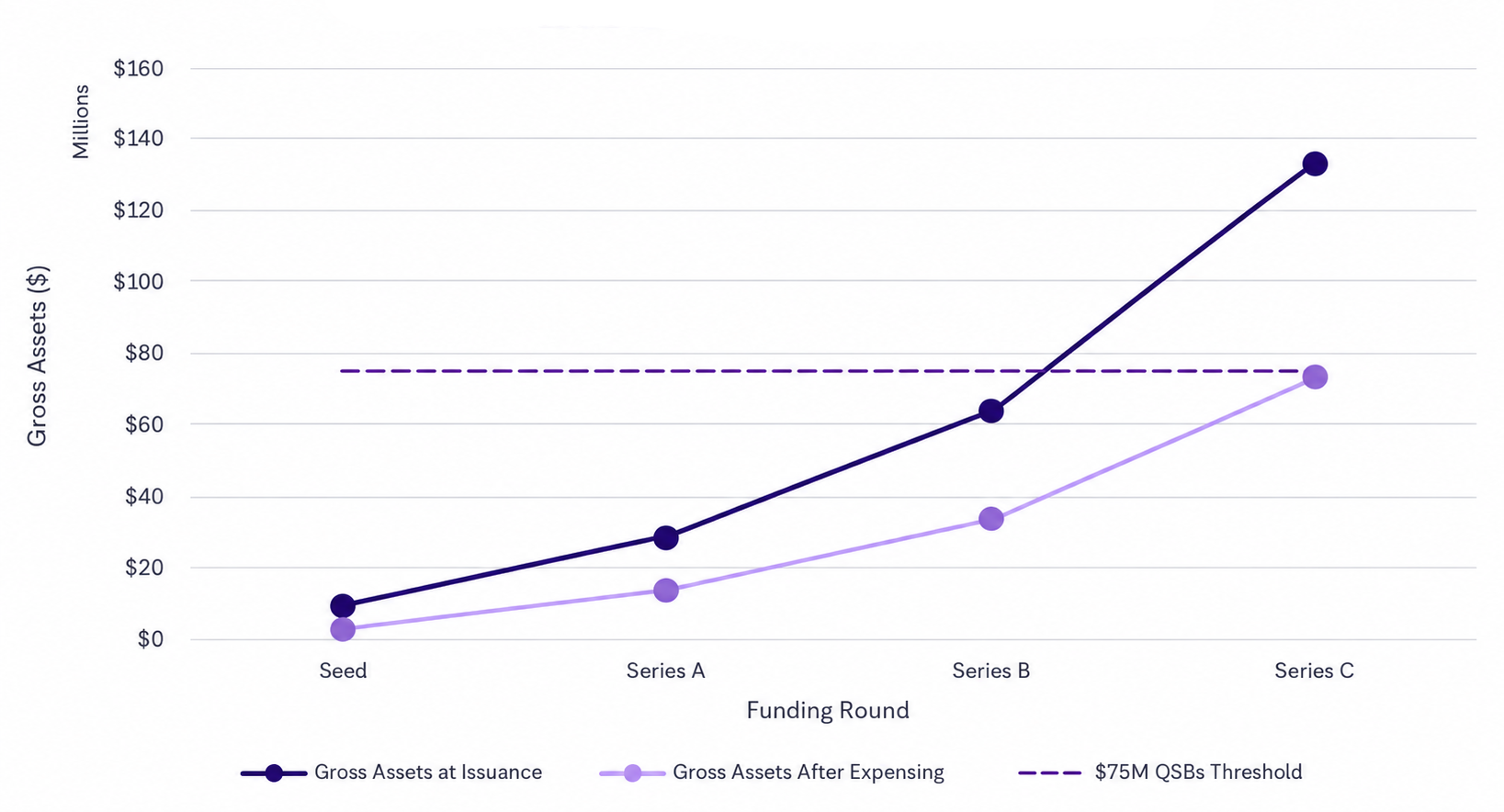
Assumptions: Company expenses 60% of capital raised via Bonus Depreciation 168(k) and R&D deductions (OBBBA). Additionally, the Aggregate Gross Assets threshold of $75M applies (post-OBBBA for stock acquired after July 4, 2025). Further, we assume the 10x Basis Rule for gain exclusion rather than the $15M fixed cap. Accordingly, Series C exceeds $75M threshold and is not eligible for QSBS exclusion. Since the $75M test applies at issuance, after new cash is received but before it can be expensed, Series B therefore qualifies just below the $75M threshold inclusive of the capital raise and gross assets on hand at the time of the close. Note that actual results depend on the corporation’s tax basis in its assets, the amount and timing of each capital raise, the use of contributed funds, the qualification of each stock issuance, the shareholder’s basis and holding period, and the application of § 1202 at the time of sale.
Keeping Your QSBS “Qualified”
Companies can inadvertently disqualify stock from the §1202 exclusion without proper planning related to transfers, redemptions, or significant transactions. Common pitfalls within QSBS qualifications may include:
- Corporate stock repurchases (redemptions) around the time of an issuance can disqualify otherwise qualifying QSBS.
- Non-qualifying businesses: The law excludes certain trades or businesses, including those where the primary corporate asset is the reputation or skill of one or more employees (service/financial fields).
- Active-business test: During the holding period, at least 80% of the corporation’s assets generally must be used to actively conduct one or more qualified trades or businesses.
- Holding-period traps: Depending on the facts, entering a binding contract to sell may affect how the gain is excluded. Timing should occur after the 3/4/5-year milestones.
- Entity Structure Changes: If QSBS is held through a pass-through entity, QSBS may pass to the partners if the partnership itself qualified and held the stock for the full period. The partner must also be a member of the partnership throughout the period.
Conclusion
QSBS can offer meaningful federal income and estate tax planning opportunities, particularly following expanded rules under the TCJA and OBBBA. Founders, investors, and their advisors should evaluate eligibility and planning options early to understand how QSBS strategies may fit within broader financial and estate planning goals. Future guidance from the IRS and the Treasury could affect certain planning techniques described above. Contact a member of your SCS team if you would like to discuss whether QSBS planning opportunities may be available and how these strategies could be integrated into your broader tax, estate, philanthropic, and wealth planning objectives.
Sources
Paul S. Lee, “Scratching the 7-Year Itch: Quantum QSBS Exclusions,” 60th Annual Heckerling Institute on Estate Planning (Jan. 2026)
Perkins Coie, “Significant Changes by the One Big Beautiful Bill Act to the Qualified Small Business Stock Provisions of § 1202” (July 2025)
Baker Tilly, “Changes to § 1202, Qualified Small Business Stock, in the One Big Beautiful Bill Act” (July 2025)
FBT Gibbons, “§ 1202 and QSBS: A Survey of States That Don’t Conform to the Federal Treatment” (Aug. 2025)
IRS Priority Guidance Plan 2025–2026: 2025-2026 Initial PGP, Item 26 (Guidance under §1202), IRS.GOV
California FTB Pub. 1004 (2012) Nance, Ryan, “QSBS gets a makeover: What tax pros need to know about Sec. 1202’s new look” Tax Adviser Magazine (Nov 30, 2025)