
Wealth Strategy – Beyond Estate Planning to Purpose and Communication
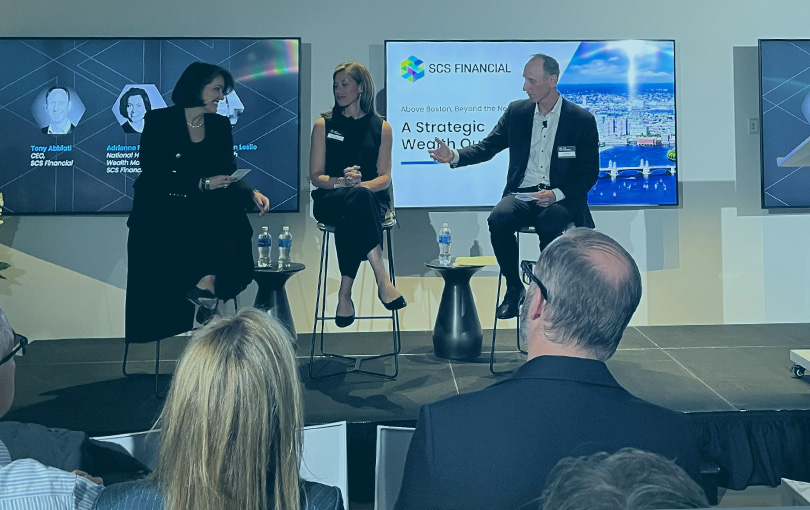
SCS’s recent Boston event brought together Tony Abbiati, CEO; Adrienne Penta, National Head of Wealth Management; and Nicole Jackson Leslie, Head of Wealth Strategy, for a dynamic discussion on the evolving wealth landscape. The following highlights key insights shared during the conversation.
Wealth Strategy Is More Than Estate Planning
At the Boston event, Tony Abbiati opened by challenging traditional perspectives on wealth planning. He turned to Adrienne Penta to explain what wealth strategy is, why it matters, and why it has become a priority for SCS. She began by sharing:
“So many people think about wealth strategy as really just estate planning—putting in place all of those pesky trust documents and wills and GRATs and CLATs… and then you sign the documents, hand them over, they go in a vault somewhere, and you’re done.”
As she explained, that’s only one piece of the puzzle. Wealth strategy really has three stages: (1) purpose; (2) planning; and (3) partnership. It should start with articulating a purpose — what families want to achieve with their wealth — not just what they want to avoid.
Then they can put that purpose into action in their gifting, estate planning, and philanthropy. The final chapter is partnership – with the next generation, fiduciaries, and others who will help carry out the plan or benefit from it.
Purpose: A Values-Based Approach
Many families start the planning process with what they want to avoid – “I don’t want my kids to lose motivation. I don’t want to pay excessive taxes.” Using family values as a starting point for planning moves families from a fear-based approach to an affirmative, purposeful approach. Adrienne emphasized:
“Values are the core of how you make decisions and how families use all of their resources, not just wealth, whether you realize it or not.”
These values — whether compassion, entrepreneurialism, or education, or likely some combination of multiple values — should be the foundation for family decisions about wealth.
Partnership: The Missing Piece
Nicole Jackson Leslie highlighted why communication and partnership with the next generation matters; even the most sophisticated estate plan can fall short if families neglect this important step because technical planning alone doesn’t guarantee success. Without clear, age-appropriate conversations, heirs may misunderstand the purpose of the wealth or make assumptions that lead to tension and conflict.
A well-designed communication plan bridges this gap. It ensures beneficiaries understand not only the mechanics of the plan, such as how trusts work and when distributions might occur, but also the motivations behind it, which may influence how discretionary distribution decisions are made. Sharing the “why” behind decisions fosters alignment, reduces surprises, and helps the next generation feel connected to the family’s values. This proactive approach transforms wealth from a source of uncertainty into a foundation for unity and stewardship.
When to Start the Conversation
Every parent asks the question: when do I start talking to my kids about money? Adrienne explained this is actually two questions.
“When do you start talking to kids about money? The answer is now — at an age-appropriate level. And when do you start talking about your money? That’s a gradual process.”
She stressed teaching financial decision making early. The core elements of financial education include: teaching kids how to distinguish needs from wants, helping them understand delayed gratification, and increasing autonomy over time.
Year-End Planning Tips
Nicole closed with a few practical planning tips as we approach the end of the year, including annual exclusion gifts, charitable donations and required minimum distributions. She also highlighted key components of the tax legislation passed in July (the One Big Beautiful Bill Act) and planning implications.
For guidance on year-end planning and family engagement, read our insight, Closing Out 2025: Strategies for Gifting, Giving, and Family Engagement.
The Takeaway
Wealth strategy is not a static checklist — it’s a dynamic process that shapes how families live, give, and lead across generations. When purpose and values drive planning, and communication bridges the gap between intent and understanding, wealth becomes a tool for opportunity, continuity, and shared vision. Families who embrace this holistic approach position themselves not only to preserve wealth but to strengthen relationships and create a legacy that lasts.
Recent Insights
IMPORTANT DISCLOSURES
The views expressed in this document, and the description of data supporting these views, are those of SCS Financial Services (together with its affiliates, “SCS”). The materials contained herein do not constitute an offer to sell or a solicitation of an offer to buy any security. Any such offering or solicitation can be made only by means of delivery of a definitive Confidential Private Placement Memorandum (“Offering Memorandum”) which sets forth in detail the terms and conditions of the offering and the applicable risk factors and should be reviewed in its entirety prior to investing. Securities may not be offered, sold or delivered to any prospective investor who does not satisfy certain minimum financial and sophistication criteria, or in any jurisdiction in which such offer is not authorized. SCS does not provide tax, accounting or legal advice and prospective investors should consult their professional advisers as to the tax or legal consequences of any potential investment.
The information in this document is as of the date indicated and is subject to change without notice. In preparing this document, SCS has relied upon certain information provided by third parties without independent verification of the accuracy or completeness of such information and SCS accepts no liability for any direct or consequential losses arising from its use.
Forward Looking Statements
Certain statements contained in this document may be forward-looking statements. By their nature, forward-looking statements involve a number of risks, uncertainties and assumptions that could cause actual results or events to differ materially from those expressed or implied by the forward-looking statements. Forward-looking statements that reference past trends or activities should not be taken as a representation that such trends or activities will necessarily continue in the future. Any economic or market forecast presented herein reflects the judgment of SCS as of the date of this material and is subject to change.
Risks
All investments risk loss of capital and there is no guarantee that an investment will achieve its investment objective. Private Fund investments in particular involve significant risks and are intended for experienced and sophisticated investors. Some of the risks associated with an investment in Private Funds include: (i) use of leverage or other speculative investment practices, (ii) illiquidity of investments including restrictions on transfers, (iii) potential multiple layers of fees and expenses, and (iv) lack of comprehensive regulatory regime. For a complete description of the risks associated with such investments please review the “Risk Factors” and “Conflicts of Interest” sections in the relevant Offering Memorandum.
Performance and Fees
Performance for the most recent time period presented may be based on estimated returns and is subject to change. Performance of individually managed accounts will vary based on constraints, timing, funding levels and other factors and may be lower or higher than any performance shown herein. Past performance is not a guide to future results.


Navigating Market Volatility — Lessons from a Tumultuous First Half
5 Key Questions Before Establishing a Family Office
Beyond Money: Focus On the Future of Family Wealth
Corporate Transparency Act: Important Updates and What It Means for Your BOI Reporting
Five Wealth Planning Strategies to Drive Success in 2025